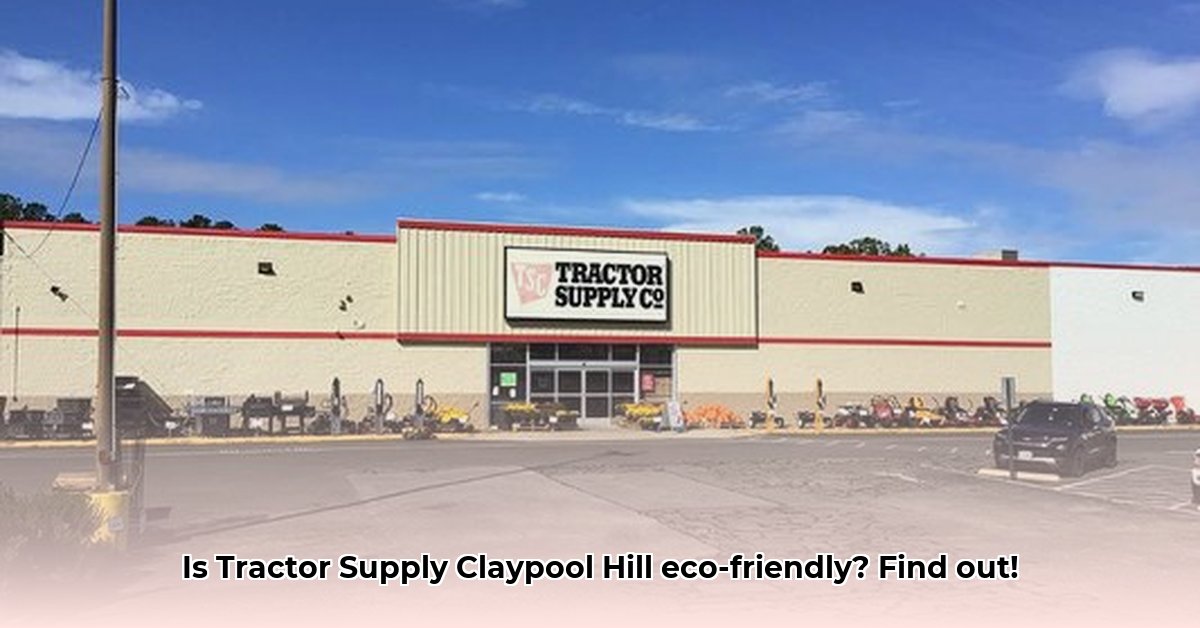
Tractor Supply Claypool Hill VA: A Sustainability Audit
Tractor Supply Company (TSC) plays a crucial role in supporting the agricultural community around Claypool Hill, Virginia. Its convenient location and wide product range are undeniable assets for local farmers and gardeners. However, a critical examination reveals a significant gap in transparency regarding the store's commitment to sustainable practices. This investigation assesses TSC's environmental impact, highlighting areas needing improvement and urging a call to action. For more information on other TSC locations, check out this helpful resource.
Accessible Resources: Convenience vs. Commitment
TSC's Claypool Hill location offers unparalleled convenience for local farmers, reducing travel distances and associated greenhouse gas emissions. "The store's proximity is a huge time-saver," says Sarah Miller, a local farmer. "It allows me to focus more on my crops." This accessibility is a significant positive, but it doesn't address the core question: how environmentally responsible are TSC's products and operations?
Beyond Convenience: Evaluating Day-to-Day Operations
While accessibility defines the *tractor supply claypool hill va* store's appeal, the daily operational choices also impact sustainability. For example, the availability of propane tank refills, while convenient, raises questions about the sourcing and emissions associated with propane production and transportation. Exploring opportunities for reduced packaging or improved recycling programs would demonstrate a commitment to *praktik berkelanjutan*, even amidst daily business functions. Analyzing these seemingly small factors offers a more complete picture of the store's overall environmental footprint.
The Sustainability Deficit: Unanswered Questions
Despite its importance to the community, TSC's sustainability efforts remain largely opaque. Key questions remain unanswered, hindering a comprehensive assessment of its environmental impact:
Sourcing Transparency: What percentage of TSC's products are sustainably sourced? The lack of readily available information on the origin and production methods of seeds, fertilizers, and animal feed is a major concern. This lack of transparency makes it impossible to determine the true environmental footprint of TSC's offerings.
Waste Management Practices: What waste reduction and recycling initiatives are in place at the Claypool Hill store? Information about packaging materials, recycling programs, and waste disposal methods is absent from public information channels.
Animal Feed and Greenhouse Gas Emissions: Animal feed is a significant contributor to greenhouse gas emissions. What type of feed is sold at TSC, and what is its carbon footprint? Data on the feed's sustainability and its overall impact on emissions is conspicuously unavailable.
Water Conservation Strategies: Water is a precious resource, especially in agriculture. What water conservation solutions does TSC offer its customers? The absence of information on water-efficient products or advice leaves a critical gap in the assessment.
Stakeholder Perspectives: A Need for Collaboration
Local farmers express a desire for greater transparency from TSC. "We need to know if the products we're buying are truly sustainable," explains James Thompson, a longtime Claypool Hill farmer. Meanwhile, attempts to obtain information from TSC management regarding its environmental practices proved unsuccessful. Effective assessment requires open collaboration between TSC, local farmers, and perhaps even the local government to establish clear sustainability metrics and practices.
A Call to Action: Demanding Greater Transparency
TSC has a responsibility to provide clear and concise information about its sustainability practices. Consumer demand for transparency and accountability is essential. We urge TSC to take immediate action in the following ways:
Publish a Sustainability Report: A detailed report outlining sourcing practices, waste management strategies, and greenhouse gas emission calculations will provide much-needed transparency.
Collaborate with Local Farmers: Work with farmers to develop and test more sustainable practices and sourcing initiatives to align with community needs and regional environmental sensitivities.
Enhance Product Labeling: Clearly label products indicating their sustainability certifications (organic, fair trade, etc.), empowering consumers to make more informed choices.
Conclusion: Sustainable Agriculture Requires Collective Effort
The sustainability of agriculture in Claypool Hill requires a collective effort. Tractor Supply, as a key player in the local agricultural supply chain, must embrace greater transparency and actively pursue sustainable practices. Only through open communication, collaborative efforts, and data-driven accountability can we build a more sustainable future for farming in this community. The path to a sustainable agricultural system begins with informed choices, and TSC has a leading role to play.